
ADEA Co-Convenes Inaugural Sino-African Dialogue on Industry-Responsive TVET, Paving the Way for the Education and Skills Summit Series
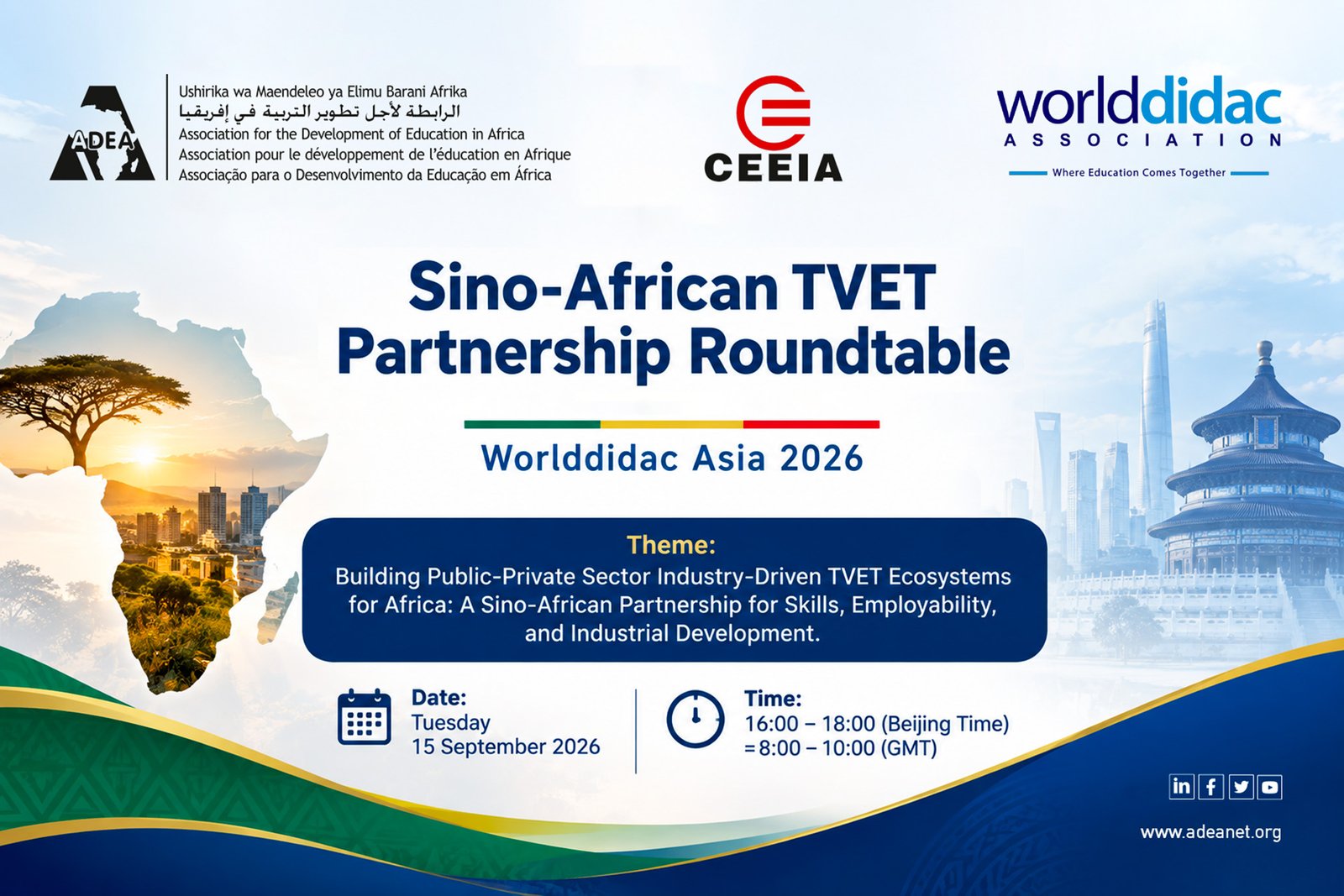
15 September 2026 – The Association for the Development of Education in Africa (ADEA) joined the Worlddidac Association and the China Educational Equipment Industry Association (CEEIA) to convene the inaugural roundtable on Sino-African Education and Skills Summit Series under Worlddidac Asia. Held under the theme “Building Public-Private Sector Industry-Driven TVET Ecosystems for Africa: A Sino-African Partnership for Skills, Employability, and Industrial Development,” the convening brought together African policymakers, education leaders and private-sector representatives with Chinese industry and education actors to address one of the continent’s most pressing challenges: closing the gap between the competencies produced by education systems and those required by rapidly evolving industries. The session set out to develop a roadmap on improving Sino-Africa collaboration on skills training and knowledge exchange.
Opening the dialogue, Dr. Rodrigo Saez, Secretary General of the Worlddidac Association, called for the complementary strengths of Africa and China in education and skills development to be transformed into concrete partnerships. He stressed the need for technical and vocational education and training (TVET) systems to become more employer-driven and demand-led, noting that the persistent disconnect between training and changing industry needs requires closer coordination between education and employers:
“Technical and vocational systems have been designed at a distance from the industries they serve, producing graduates for jobs that no longer exist, while employers struggle to fill the ones that do. That gap is a governance problem, not only a funding one.”
He announced the formal launch of the Sino-African Education and Skills Partnership Initiative, setting in motion the process for ADEA, CEEIA and Worlddidac to nominate focal points to a Joint Working Group tasked with translating the dialogue into a concept paper and governance structure over the coming months.
Addressing participants, ADEA Executive Secretary, Albert Nsengiyumva, identified the mismatch between training provision and labour-market demand as a persistent challenge across African countries. He stressed that employers must play a central role in preparing young Africans for work and encouraged countries to look beyond classroom-based learning towards practical competencies acquired through industries, training centres and workplace environments. Connecting this to the broader question of Africa’s economic transformation, he noted,
“It is not just about investing or economy. It’s about how people benefit from the investment, and one way of benefiting from that is actually to get the required skills and experience.”
It is in this context that China's development trajectory emerged as an important reference point for the exchange, particularly its experience in connecting technical education with infrastructure, manufacturing and economic transformation. Representing CEEIA, Secretary General, Li Ying, highlighted opportunities to build on the Belt and Road Initiative through a two-way approach that combines investment with sustainable technical and vocational capacity development. He outlined a model in which enterprises act as co-designers of curricula and participate throughout the training process, ensuring programs respond to actual job requirements and practical competencies. Qualification and certification frameworks, quality assurance, teacher training and targeted programs in manufacturing, infrastructure and energy, and digital and green industries were also identified as important areas for exchange. Summarizing the approach, he noted:
“Industry sets the question, education sets the answer.”
For African countries, the relevance lies not in replicating China's model, but in drawing lessons from how skills development has been deliberately connected to industrial and economic priorities. African education ministry representatives shared their experiences, identifying common gaps and areas where deeper engagement could add value. Nigeria presented its ongoing efforts to revitalize technical and vocational education through a new policy strengthening links with employers. The Nigerian Ministry of Education has placed technical and vocational education at the center of its national development agenda and is updating its National Occupational Standards and streamlining training around priority sectors to better align skills development with industry and economic needs. Illustrating the scale of this ambition, the Government is investing ₦1 billion in TVET and targeting the training of nearly one million young Nigerians, with a focus on a practical curriculum to ensure hands-on experience for employment and entrepreneurship. As Nigeria moves from policy ambition to large-scale delivery, the country expressed interest in connecting with relevant Chinese institutions and companies to expand training opportunities aligned with labor-market needs, enabling more young Nigerians to acquire the skills required by growing industries and Chinese-supported projects.
Kenya demonstrated how existing collaboration can contribute to national reform. The country pointed to Chinese support in equipping training institutions with modern technologies, alongside implementation of the Kenya National TVET Strategy and the transition from examination-oriented training towards competency-based education and training. Technology transfer and capacity building for trainers were identified as priority areas for further engagement, helping graduates acquire competencies that more closely correspond to workplace requirements.
Experiences from Ghana and Rwanda further illustrated the importance of stronger links between training and the world of work. Ghana shared its use of labor-market intelligence and collaboration with industry associations to identify priority occupations, anticipate workforce needs and inform curricula and assessment. Rwanda emphasized that competency-based curricula require adequate infrastructure, modern equipment and trainers who remain exposed to technological change, alongside stronger recognition of workplace learning within national qualification frameworks.
Other country experiences reinforced these priorities. Côte d’Ivoire highlighted its existing cooperation with China in financing, infrastructure and teacher development, while seeking to further improve training quality and youth employability. Tanzania pointed to collaboration in railway development, mechatronics and Artificial Intelligence, with opportunities to deepen joint curriculum development and industry participation. Senegal highlighted the Luban Workshop and its school-enterprise model as a basis for expanding cooperation in emerging and industrial sectors, while Uganda highlighted employer-led training, apprenticeships, work-based learning and exchanges of trainers and experts with China.
Together, these country perspectives reinforced a broader consensus: Africa’s skills gap cannot be addressed by education systems alone. Governments, training institutions and employers must work together to anticipate workforce needs, strengthen workplace learning, modernize training environments and facilitate technology and knowledge transfer.
The dialogue concluded with agreement on a shared vision and permanent mechanism for Sino-African engagement in TVET, grounded in participating countries’ priorities. Focal points from ADEA, CEEIA and Worlddidac will form a Joint Working Group to develop the initiative’s concept and governance structure and advance a 2027–2032 cooperation roadmap. The process will also explore a private-sector charter for technical education and skills development, peer learning, industrial exposure for students and trainers, technology and knowledge exchange, and greater inclusion of women, youth and underserved communities. ADEA will serve as the African convening partner, articulating African priorities; CEEIA will coordinate Chinese educational institutions and industry actors; and Worlddidac will provide a neutral platform for sustained dialogue.
For ADEA, this moment yet again underscores its capacity to facilitate policy partnerships for the benefit of its member countries, helping them articulate their priorities, learn from relevant international experience and connect with partners that can support implementation. Building on this first exchange, the partners will work towards an in-person convening in 2027 and a sustained Sino-African Education and Skills Summit Series that brings countries and partners together for peer learning, translate policy dialogue into practical action, and helps ensure that Africa’s industrial growth is matched by the human capital required to sustain it.
