
Ministers Endorse Africa-led Framework to Track Foundational Learning Commitments at 8th Ministerial Coalition Meeting
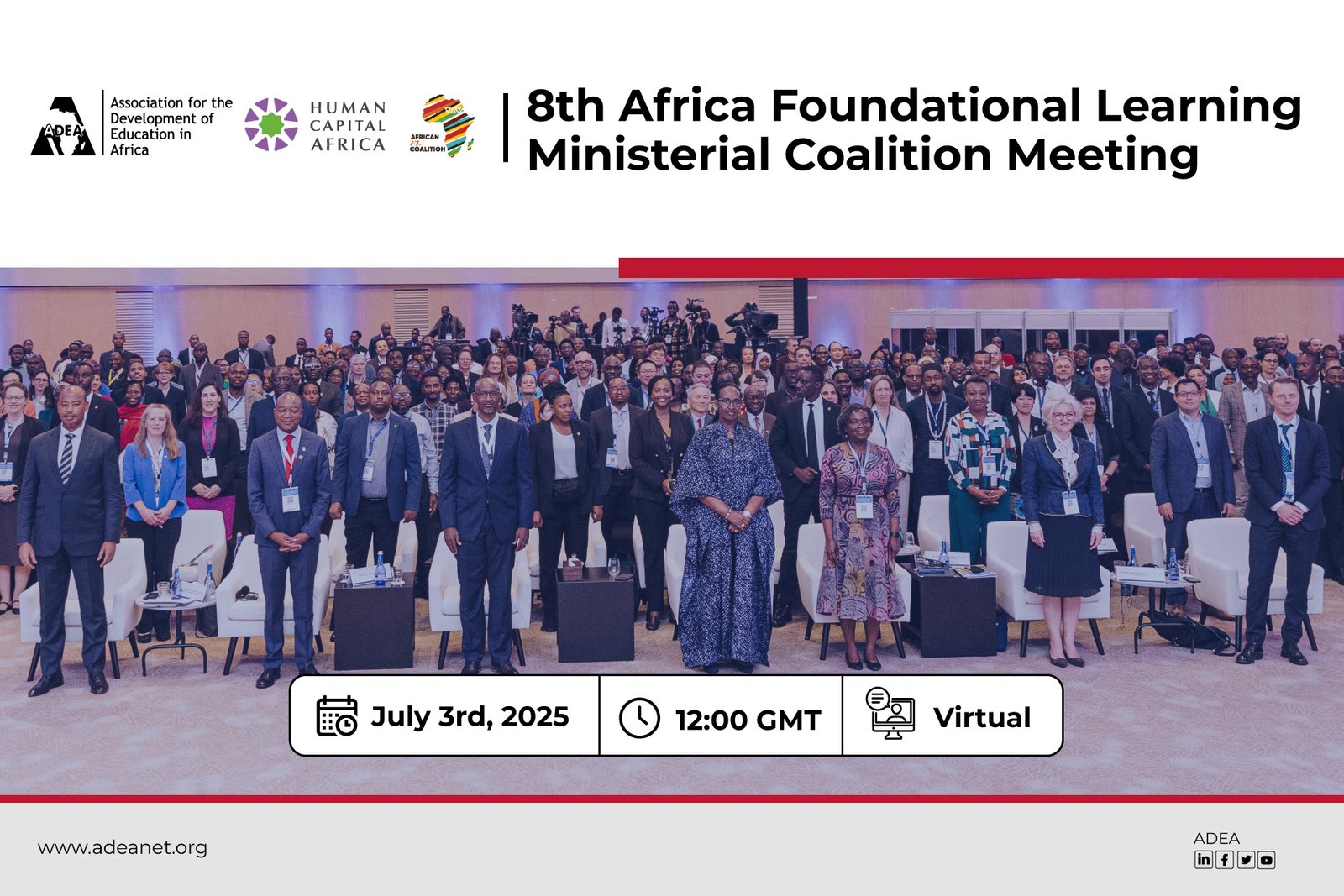
The 8th convening of the Africa Foundational Learning Ministerial Coalition (AFLMC), co-hosted by the Association for the Development of Education in Africa (ADEA) and Human Capital Africa (HCA), brought together African Ministers of Education, technical focal points, and development partners. The high-level meeting was held on Thursday, 3rd July and chaired by the Honourable Douglas Syakalima, MP, Minister of Education for the Republic of Zambia. The meeting centered on advancing a continental accountability framework to track foundational learning (FL) progress and position FL as a priority on the global agenda.
In his opening remarks, Minister Syakalima welcomed the steady evolution of the Coalition from a platform for dialogue into a catalyst for action. He applauded the appointment of technical focal points in 25 countries and emphasized the importance of strengthening national capacity, data-informed policymaking, and accountability.
“This shift introduces a level of continuity and technical coordination that ensures follow-through on commitments. We must now focus on strengthening national technical capacity, promoting data-informed decisions, and enhancing accountability,” he said.
Dr. Obiageli Ezekwesili, founder of Human Capital Africa, echoed this sentiment, noting that
“the Coalition has evolved in both form and function, driven by the leadership and commitment of ministers. The shift to ministerial leadership is a decisive move toward true self-ownership of the foundational learning agenda.”
The convening featured rich discussions on the following key areas:
- Africa FL Accountability Framework: ADEA’s Senior Foundational Learning Expert, Dr. Jacqueline Jere-Folotiya, presented a draft framework designed to help countries track their progress on the five core FLEX2024 commitments. The framework includes indicators on evidence-based practices, data use, and foundational learning financing. It is intended to complement existing national accountability systems and will be finalized ahead of its formal launch at the ADEA 2025 Triennale in Accra.
- FLIGHT Initiative: Dr. Benjamin Piper, Director of Global Education at the Gates Foundation, introduced the Foundational Learning Initiative for Government-led Transformation (FLIGHT). This initiative aims to provide technical support in pedagogy, education technology, and systems strengthening to countries that demonstrate a clear commitment and investment in foundational learning. A key feature of FLIGHT is its focus on mobilizing African expertise for local solutions in an era of dwindling donor funding.
- South Africa’s G20 Presidency: Ms. Kulula Manona from South Africa’s Department of Basic Education shared updates on the inclusion of foundational learning as a priority under the country’s G20 presidency. South Africa is advocating for a G20 declaration on foundational learning and has proposed a global learning exchange to share knowledge and best practices.
As the host country for the meeting, Zambia had the opportunity to showcase its progress in FL through its “Catch-Up” program, highlighting the recruitment and training of nearly 17,000 teachers and the targeted training of college and university lecturers to embed sustainable change in instructional practices.
In conclusion, ADEA shared updates on key upcoming advocacy opportunities, including the G20 Education Working Group learning exchange, the 80th session of the United Nations General Assembly in September, and the ADEA Triennale scheduled for October 2025 in Accra, Ghana.
Closing the meeting, Dr. Ezekwesili emphasized the need for continued visibility, political leadership, and country-level ownership of the foundational learning agenda. She encouraged remaining countries to nominate technical focal points and prioritize foundational learning in national education reforms.
The 8th AFLMC meeting reaffirms the Coalition’s role as a strategic platform to support African governments in achieving the goal of ending learning poverty by 2035 through collaboration, accountability, and innovation.
