
Design and Pilot Testing of a Blended Exchange Learning Trajectory (BELT) for African Education Policymakers on School Leadership
1. Background and Context
Education systems across Sub-Saharan Africa are undergoing reforms to improve learning outcomes, teacher effectiveness, and system governance. School leadership has emerged as a critical lever for transformation, with strong evidence linking effective leadership to improve school performance and student achievement. Global evidence confirms that school leadership is the second most important factor for learning outcomes after teaching (OECD; World Bank).
However, policy design and implementation gaps continue to limit impact on scale. Evidence from global research demonstrates that reforms fail when policymakers lack applied system leadership capacity. Traditional training models are too theoretical and not embedded in real policy processes.
In its efforts to contribute to addressing this gap, the African Centre for School Leadership (ACSL) is planning to develop and deliver a Blended Exchange and Learning Trajectory for policymakers, offering an opportunity to enhance long-term capacity about contextually relevant approaches to strengthening school leadership policy frameworks in order to improve teaching and learning outcomes.
The African Centre for School Leadership (ACSL) is a pan-African initiative jointly coordinated by the Association for the Development of Education in Africa (ADEA), Education Sub-Saharan Africa (ESSA), Forum for African Women Educationalists (FAWE), and VVOB – education for development. ACSL’s ambition is to build supportive school leadership systems that strengthen teaching and improve learning outcomes and well-being for all. To achieve its ambition, ACSL has conducted comprehensive school leadership mapping studies at continental and country levels, with the aim of developing a clear and shared understanding of school leadership systems, frameworks, and innovations across Africa. At country level, ACSL is active in eight countries: Rwanda, Kenya, Ghana, Uganda, Tanzania, Malawi, Sierra Leone, and Liberia.
Evidence from these mappings highlight systemic challenges, including:
- Weak and/or non-transparent leadership career pathways
- Limited professional development for school leaders
- Fragmented policy frameworks and implementation gaps
- Gender disparities in leadership representation
- Limited capacity of policymakers to translate evidence into reform
To address these challenges, there is a need for a structured, scalable, and practice-oriented capacity development and Afrocentric approach targeting education policymakers and system leaders.
2. Objectives of the consultancy
Overall Objective:
To develop the capacity of African education policymakers on strengthening school leadership for improved learning outcomes through a Blended Exchange Learning Trajectory (BELT).
Specific Objectives:
- Develop content based on the priority areas from the ASCL continental and country mappings as well as previous work by VVOB and other development partners.
- Develop course modules based on the content developed.
- Test the modules with selected target countries.
3. Scope of Work
The selected service provider will be responsible for the developing the course content, designing the course modules for online and in-person delivery, and pilot testing and making relevant adjustments to the course modules of the blended learning trajectory.
3.1 Content Development Phase
- Review ACSL–LIT–LEAD school leadership mapping reports and other relevant literature on the matter.
- Identify capacity gaps and priorities in school leadership policy development in Africa.
- Develop the course content based on the priorities and design a structured learning pathway that integrates comparative insights, and transformative and Afrocentric school leadership approaches – including Ubuntu, community-based governance, and equity-centered leadership
3.2 Module Design Phase
- Design the online (asynchronous) and in-person learning modules
- Design blended and interactive sessions (virtual and/or in-person)
- Create policy labs and applied learning exercises where education policymakers can work on real reforms, produce actionable policy outputs, and receive expert coaching.
- Develop knowledge products (guides, toolkits, case studies from the 5 ACSL mapped countries and the expanded countries)
- Anchor all relevant products and documents on the designated ACSL/ LIT-LEAD initiative.
3.3 Pilot test delivery mode
- Online:
- 60–70% online (self-paced modules).
- 30–40% synchronous sessions (virtual/in-person).
- In Person Session: Convene a yearly 3-5 day continental in person seminar, where high level education Policymakers can exchange, learn and reflect on good practices (could be linked to a continental convening, where an in-person seminar can be held).
- Platforms: ACSL Moodle platform, ADEA-organized in-person sessions.
4. Target Beneficiaries
The program will target education policymakers and heads of relevant government agencies in selected countries:
- Ministers, Deputy Ministers, Permanent Secretaries, Directors General of Education in selected countries.
- CEOs of key government agencies and parastatals.
Estimated Cohort Size:
- 20–60 gender balanced participants across countries (indicative)
- It is anticipated that the training will cover two cohorts per year (1 per semester starting in January 2027)
5. Institutionalization and Sustainability
The service provider should propose mechanisms to ensure sustainability. The proposed solutions should be adaptable across countries and compatible both with continental frameworks and government systems.
6. Key Deliverables and Milestones and schedule of payment:
This is a strictly performance-based contract and payment of fees is subject to the delivery of products and milestones as follows:
Duration: 6 months
| Deliverable | Description | Timeline | Payment |
|---|---|---|---|
| Inception Report | Methodology, workplan, stakeholder engagement plan | 15 days upon contract signature | 20% of fees |
| Content development | Competency framework and content | 1 Month | 10% of fees |
| Draft Learning Modules | Course modules drafted. | 3 Months | 30% of fees |
| Configuration of the modules in the provided platform | LMS configuration | 1 Month | 10% of fees |
| Report of the Pilot Testing | Outcome of tested modules, used to make further adjustments | TBD | 15% of fees |
| Final Report including the content development, module design, and platform configuration, testing, and adjustment | Presentation of products and deliverables | 15 days | 15% of fees |
7. Key Partners and Institutions
The service provider is expected to collaborate with:
- Ministries of Education and relevant government agencies in participating countries
- Continental and regional education bodies and coordination mechanisms on school leadership (AU-ESTI, AU-CIEFFA, AFTRA, IIEP, RECs, etc.)
- Development partners supporting school leadership reforms.
8. Required Experience and Capacity
Institutional Requirements:
- Proven experience in education policy and school leadership reform.
- At least 10 years of proven experience, working on education policy analysis and planning in different parts of Africa (Anglophone, Francophone in particular), especially in school leadership.
- Experience in the development blended learning and digital education. Such as experience with respect to school leadership would ve add asset.
Technical Expertise:
- Curriculum and instructional design
- Education policy analysis and planning, with a bias on school leadership where possible.
- Gender-responsive education
- Monitoring and evaluation
Team Composition:
Submission should include team composition and roles.
9. Budget (Illustrative)
| Cost Category | Estimated Cost (USD) |
|---|---|
| Content Development | |
| Module Design & Curriculum Development | |
| Platform Configuration, Testing | |
| Total Estimated Budget |
Note: Bidders must submit detailed and justified financial proposals
10. Evaluation Criteria
| Criteria | Weight |
| Technical quality of proposal | 35% |
| Relevant experience | 20% |
| Team expertise | 20% |
| Cost-effectiveness | 15% |
| Afrocentric relevance | 5% |
| Innovation in Learning design | 5% |
| TOTAL | 100% |
11. Application and Selection Criteria
Interested consortia / firms should submit:
- Technical proposal outlining approach, methodology, and workplan.
- Relevant organisational and team composition, expected roles, experience.
- Financial proposal (detailed budget)
- Samples of similar assignments and evaluation reports.
Selection will be based on technical quality, relevance of experience, methodological robustness, and value for money.
12. Expected Start Date
The institution/consortium engagement is expected to commence in September 2026, subject to contracting and finalisation of scope.
13. How to apply
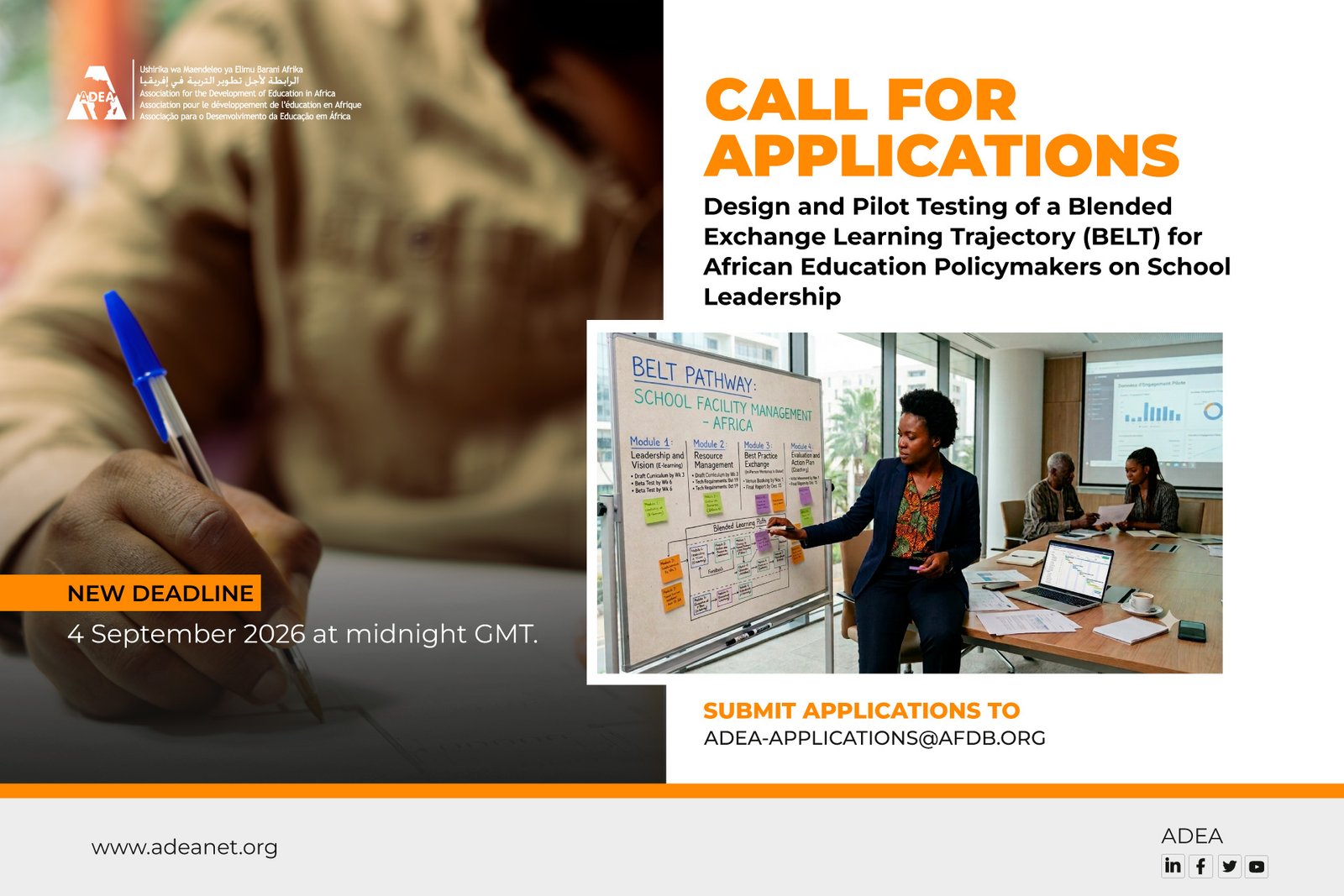
Interested applicants should submit their proposals to ADEA-APPLICATIONS@AFDB.ORG no later than 4 September 2026, at midnight GMT.
