
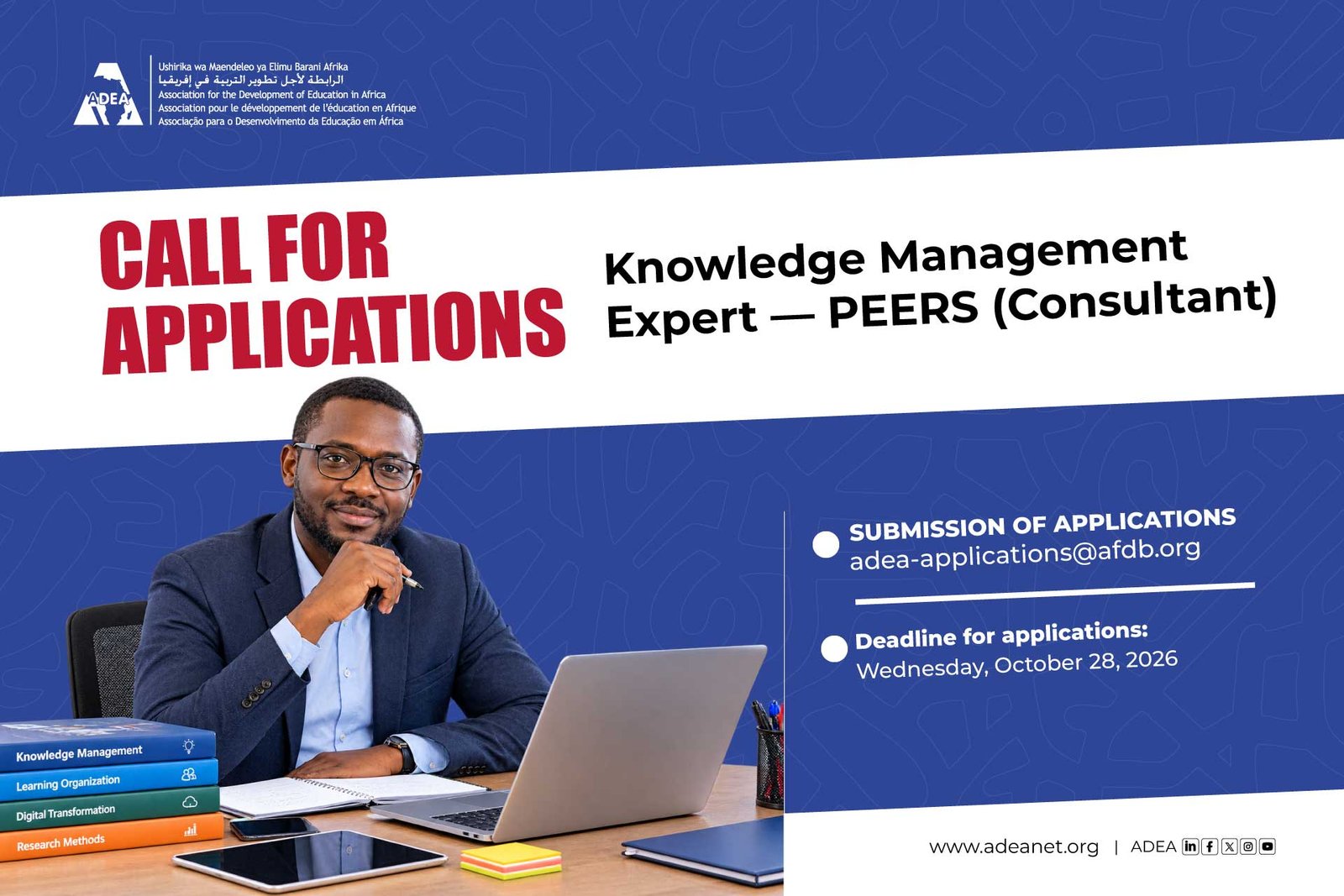
Call for Applications: Knowledge Management Expert – PEERS (Consultant)
1. Introduction
The Association for the Development of Education in Africa (ADEA) is a pan-African organization with an international legal personality and a critical voice of education in Africa. ADEA’s vision is “a high-quality education and training system for accelerated sustainable development of Africa.” To realize this goal, ADEA “serves as an open and flexible pan-African organization that informs and facilitates the transformation of education and training systems for resilience, human capital development, and youth empowerment in Africa.” Under the strategic plan 2024–2028, ADEA’s overall goal is to help African countries transform schooling into meaningful learning.
2. About PEERS
The Africa–Europe Partnership to Exchange on Education Reforms (PEERS) is supported by the European Union and implemented by Expertise France (coordinator of the implementing partners), ADEA and the Finnish National Agency for Education (EDUFI), in close collaboration with two African Union Regional Economic Communities (RECs): the East African Community (EAC) through its Secretariat and the Economic Community of West African States (ECOWAS) through its Commission. PEERS aims to strengthen the coordination capacity of the EAC and ECOWAS in supporting their respective Partner and Member States to develop or reform national basic education policies so that they are of greater quality and more inclusive and equitable.
The three Specific Objectives are:
- Enhance cooperation between and within the ECOWAS and EAC regions in the design, implementation and monitoring of quality, gender-responsive, inclusive, green and digital education policies;
- Increase mutual learning and the effective transfer of good practices and tools on quality, gender-responsive, inclusive, green and digital education between the EU, ECOWAS, the EAC and their Member States;
- Leverage evidence and promote knowledge exchange for enhanced evidence-based quality, inclusive, gender-responsive, green and digital education policies in the ECOWAS and EAC regions.
The intervention focuses on the RECs’ Secretariats and Commission in their coordination role, through regional dialogue, thematic Technical Working Groups, peer learning, and evidence-informed policymaking, rather than direct country-level implementation.
Under PEERS, the KM function will therefore operate at two complementary levels: strengthening KM within the EAC Secretariat and ECOWAS Commission, while also structuring KM within the PEERS project to support knowledge sharing, learning, and evidence use across the team, consortium partners, and thematic Working Groups. This will include strengthening linkages with research institutions, knowledge platforms and communities of practice, including the ADEA Knowledge Hub, and supporting the dissemination and uptake of evidence and recommendations generated through PEERS.
3. Purpose of the Assignment
ADEA seeks to recruit a Knowledge Management Expert to develop and operationalize the PEERS knowledge management function, ensuring that knowledge, evidence and learning generated through the project are systematically captured, synthesized, shared and used to inform project implementation, peer learning and policy dialogue.
The Expert will also support the EAC Secretariat and the ECOWAS Commission, according to their priorities and level of engagement, to consolidate sustainable approaches for accessing, interpreting, synthesizing, sharing and applying knowledge and evidence in support of regional education policy coordination and harmonization. Particular emphasis will be placed on strengthening the links between thematic Technical Working Groups, research and evidence providers, regional policy processes and decision-making structures, and on promoting collaboration with relevant knowledge networks and platforms, including the ADEA Knowledge Hub.
The assignment will be delivered through a collaborative, demand-driven technical assistance approach that promotes REC ownership, institutionalization, sustainability and the progressive transfer of knowledge management functions to designated REC counterparts. All support will be aligned with the mandates, systems, structures, languages and priorities of the EAC Secretariat and the ECOWAS Commission, and will complement existing institutional functions, processes and ongoing initiatives that strengthen these functions at the EAC level.
4. Key Responsibilities
The Knowledge Management Expert will support the reinforcement and operationalization of a practical knowledge management function within the EAC Secretariat and the ECOWAS Commission. The Expert will work in close collaboration with REC counterparts, PEERS Technical Assistants, thematic experts and the core team to strengthen knowledge management, evidence use, learning and policy dialogue. The Expert will also support the PEERS team and consortium partners to identify priority knowledge questions and ensure that evidence and learning inform strategic and operational decision-making.
4.1 Knowledge management strategy and coordination
- Establish a shared definition and vision of knowledge management within PEERS, clarifying its scope, objectives, added value and articulation with the MEAL, communications and advocacy functions, and translate this into a practical approach for the PEERS team, consortium partners and the RECs.
- Develop and periodically update the PEERS knowledge management strategy and annual workplans.
- Support the establishment or strengthening of practical and sustainable knowledge management functions within the EAC Secretariat and the ECOWAS Commission.
- Ensure that knowledge management activities are aligned with PEERS objectives, Technical Working Group priorities and emerging evidence needs from the RECs.
- Support the integration of knowledge management priorities into relevant REC plans, processes and regional dialogue mechanisms.
4.2 Mapping, design and operationalization
- Map existing knowledge management practices, systems, capacities, workflows and information flows within the EAC Secretariat and the ECOWAS Commission.
- Identify knowledge and evidence needs, gaps, opportunities and challenges affecting the work of the thematic Technical Working Groups.
- Map relevant research institutions, knowledge platforms, peer-learning networks and communities of practice across the PEERS focus areas.
- Develop, for both the PEERS management function and the RECs, knowledge management concept notes and costed action plans defining priorities, actions, responsibilities, resources and implementation arrangements.
- Support the implementation of agreed knowledge management approaches, processes, tools and practices.
- Provide recommendations, on demand, to the EAC Secretariat and the ECOWAS Commission on practical approaches for organizing, accessing, sharing and using knowledge and evidence in support of policy dialogue and coordination.
4.3 Evidence, brokerage and knowledge exchange
- Facilitate collaboration and stronger linkages between REC staff, thematic Technical Working Groups, research institutions, evidence producers, knowledge platforms, peer-learning networks and communities of practice, to promote the exchange, synthesis and application of evidence in regional policy dialogue, peer learning and education policy coordination.
- Support the identification, retrieval, synthesis, contextualization and use of evidence in response to Technical Working Group priorities.
- Promote the systematic capture, dissemination and application of lessons learned, good and emerging practices, implementation experiences and evidence generated through the thematic Technical Working Groups, peer-learning activities, Africa–Europe exchanges and other PEERS-supported initiatives.
- Identify evidence gaps and support the preparation of research questions, terms of reference and commissioned studies where required.
- Promote collaboration with relevant knowledge platforms and networks, including the ADEA Knowledge Hub and those identified in platform mapping.
4.4 Knowledge products, dissemination and policy uptake
- Work with the PEERS technical team — the Technical Assistant in Education Policies (TAEP), the Long-Term Experts (LTEs) and the MEAL Coordinator — on the preparation of knowledge products responding to the priorities of the RECs, the PEERS team and the thematic Technical Working Groups.
- Support the dissemination of evidence, lessons learned and recommendations through REC structures, regional and continental platforms, the ADEA Knowledge Hub and other relevant channels.
- Work with PEERS technical, advocacy and communications colleagues to package knowledge products for different audiences and strengthen policy uptake.
- Support the use of evidence and of Technical Working Group recommendations in regional and continental policy dialogue forums, peer-learning activities, reporting processes and high-level events.
4.5 Collaborative learning and sustainability
- Support thematic Technical Working Group members to strengthen their ability to access, interpret, synthesize, share and use evidence for policy dialogue and decision-making.
- Develop practical guidance, tools, templates and resources supporting the application of knowledge management approaches within the thematic Technical Working Groups.
- Promote institutional ownership of knowledge management functions, processes and practices through a collaborative learning and development approach, and support the progressive transfer of responsibilities, tools and approaches to designated REC counterparts.
- Document lessons learned and contribute to the sustainability and institutionalization of knowledge management functions beyond project-supported activities.
5. Key Deliverables
- PEERS knowledge management strategy and annual workplans. A practical strategy and annual workplans, agreed with the RECs and the project team, defining priorities, implementation approaches, activities, responsibilities, timelines and resource requirements. The strategy also clarifies roles, responsibilities and coordination mechanisms across the knowledge management, MEAL, communications and advocacy functions, alongside the finalization of the MEAL plan.
- Knowledge management diagnosis and knowledge ecosystem mapping for the RECs. An analysis of existing practices, capacities, information flows, systems, evidence needs and institutional gaps within the EAC Secretariat and the ECOWAS Commission, together with a mapping of relevant research institutions, knowledge platforms, communities of practice and evidence providers, to inform the design of REC-specific interventions.
- REC knowledge management concept notes. REC-specific concept notes setting the strategic direction: recommendations and priority actions for strengthening knowledge management, evidence use and knowledge exchange within the thematic Technical Working Groups of the EAC Secretariat and the ECOWAS Commission.
- Costed knowledge management action plans. The budgeted translation of the concept notes under Deliverable III: prioritized action plans setting out implementation arrangements, responsibilities, resource requirements, timelines and sustainability measures.
- Knowledge management approaches, processes and tools. Practical approaches, processes, tools and guidance that strengthen the identification, access, synthesis, sharing and use of evidence within the thematic Technical Working Groups, with progressive transfer of ownership to designated REC counterparts.
- Evidence and knowledge products. Evidence briefs, policy and practice briefs, research syntheses, learning notes, case studies and other products developed in response to REC priorities, Working Group requests and PEERS learning objectives.
- Knowledge exchange and policy uptake support. Reports of technical support provided to thematic Technical Working Groups, peer-learning activities, policy dialogue processes, dissemination initiatives, Africa–Europe exchanges and high-level events.
- Periodic progress and learning reports. Reports documenting progress, achievements, challenges, lessons learned and recommendations from the implementation of knowledge management activities, feeding project learning, adaptive management, MEAL processes and the progress reports to the donor.
6. Working Arrangements and Reporting
The Expert will be part of ADEA’s PEERS implementation team and will report to the ADEA Senior Programmes Officer, working in close coordination with the Education Technical Advisor and, at strategic level, the ADEA Executive Secretary.
The Knowledge Management Expert will work in close collaboration with the PEERS Project Lead, the Technical Advisor, Regional Coordinators, Technical Assistants, Thematic Experts, and the MEAL, advocacy and communications colleagues. He or she will also engage with designated focal points within the EAC Secretariat and the ECOWAS Commission.
Priorities and annual workplans are agreed within the PEERS consortium. Support will be delivered through a collaborative, capacity-strengthening approach that promotes REC ownership and sustainability and respects the mandates and responsibilities of the EAC Secretariat and the ECOWAS Commission.
7. Qualifications and Experience
- Master’s degree in knowledge management, education, social sciences, international development, public policy, information or library sciences, communications or a related field.
- At least 8 years of progressively responsible professional experience in knowledge management, organizational learning, evidence use, education policy and programmes, research utilization or international development, preferably in Africa.
- Demonstrated experience in institutional knowledge management assessment, knowledge ecosystem mapping, evidence brokerage, research synthesis and the development of knowledge products.
- Experience working with regional organizations, education institutions, research organizations, development partners or multi-country programmes; experience with African RECs is an advantage.
- Strong understanding of evidence-informed policy processes, knowledge exchange and education cooperation in Africa.
- Strong analytical, facilitation, writing and editing skills, including the ability to translate technical evidence into concise and accessible products.
- Demonstrated ability to work collaboratively with institutional counterparts and to strengthen ownership of knowledge management processes and tools.
- Excellent interpersonal and cross-cultural communication skills, with the ability to work effectively in multicultural and multilingual environments.
- Full professional proficiency in both English and French is essential. Knowledge of Swahili and/or a West African language is an asset.
- Experience with digital knowledge-sharing platforms, collaborative tools and knowledge management systems.
8. Contractual Arrangements
Duty station. ADEA Secretariat, Abidjan, Côte d’Ivoire, with travel to the EAC Secretariat, the ECOWAS Commission and other project locations as required.
Contract duration. One year, renewable subject to satisfactory performance, project requirements and availability of funding.
Contract type. Consultant contract.
9. How to Apply
Interested candidates should submit a CV and a cover letter to adea-applications@afdb.org with the subject line “Knowledge Management Expert – PEERS (Consultant)”. The deadline for applications is 28th October 2026 at midnight (00:00) GMT.
Applicants from EAC and ECOWAS regions are highly encouraged to apply.
Due to the high volume of applications, only shortlisted candidates will be contacted, by formal email correspondence. Candidates are requested not to contact ADEA or its staff about the status of their application.
