
ADEA Triennale 2025 ends with actionable recommendations and new initiatives to transform and strengthen educational systems resilience in Africa
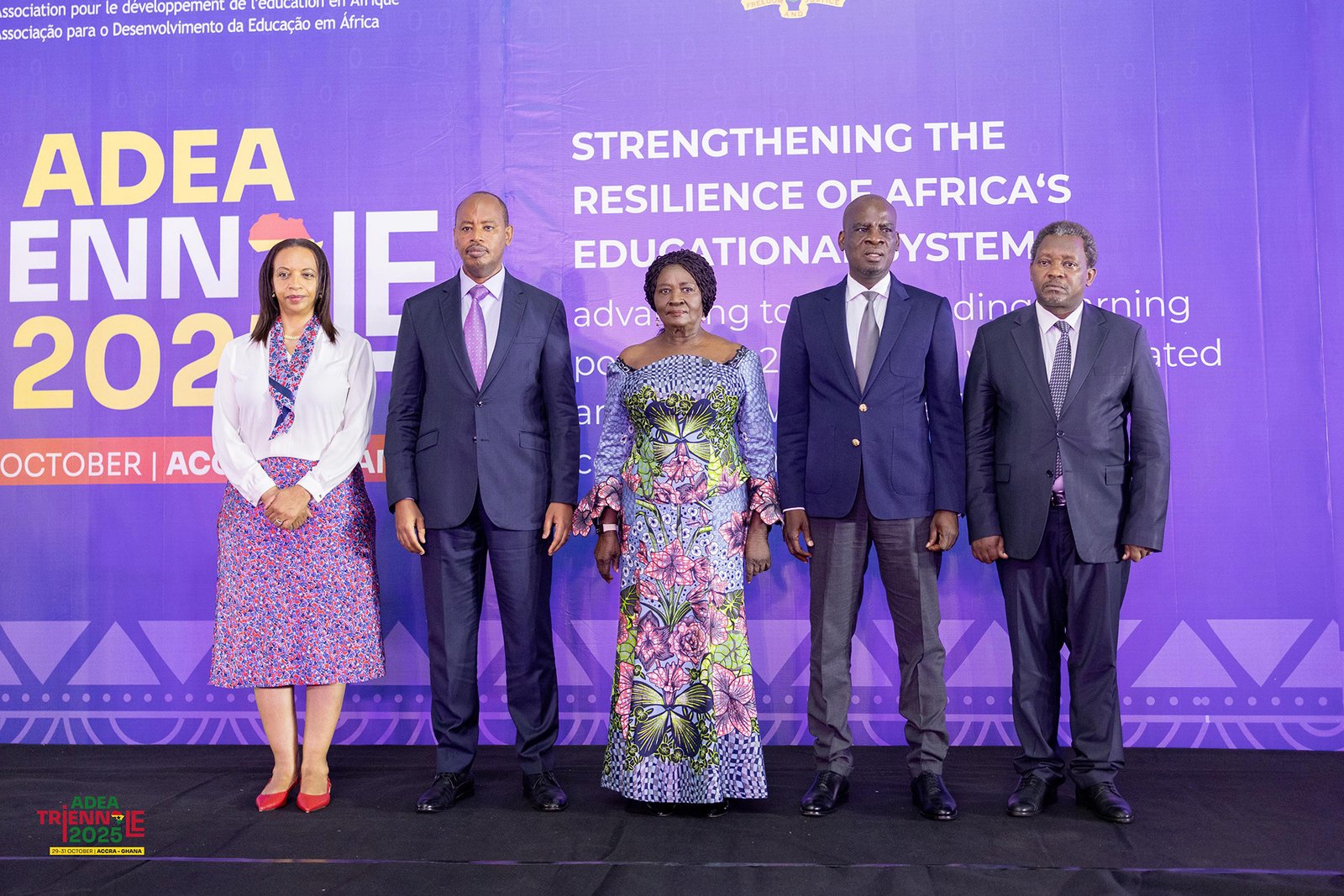
From left to right: Eyerusalem Fasika, African Development Bank Country Manager for Ghana; Albert Nsengiyumva, ADEA Executive Secretary; Her Excellency Prof. Jane Naana Opoku-Agyemang, Vice-President of Ghana; Hon. Haruna Iddrisu, Minister of Education of Ghana; Prof. Gaspard Banyankimbona, African Union Commissioner for Education, Science, Technology, and Innovation (AU-ESTI)
After three days of extensive high-level, evidence-based policy dialogue, knowledge exchange, peer learning, reflections, and bilateral engagements in Accra, Ghana, the 2025 ADEA Triennale on Education and Training in Africa ended with renewed commitment and key recommendations to reimagine education financing and develop sustainable educational systems that are inclusive, innovative, and resilient. The African education community, global partners, and stakeholders agreed to critical actions, including prioritizing domestic options to address funding gaps as governments focus on home grown sustainable financing models. A key outcome on education financing is the need for countries to commit a minimum of 20% of their national budget to finance education.
Other recommendations include prioritizing early childhood education and foundational learning, aligning school curriculum with labor market needs and strengthening the transition from secondary education to the world of work, promoting evidence-based decision-making in education, investing in research and innovation towards solutions for the continent, embracing technology in education to reach marginalized populations, strengthening Afrocentric educational leadership by aligning it with continental standards for effective school leadership, and investing in and institutionalizing nationwide second-chance education programmes that are flexible, affordable, and accessible to learners with diverse capabilities, including refugees.
Meanwhile, four new initiatives were announced to help African countries move towards achieving their respective educational objectives and realizing some of the recommendations from the Triennale. These include the Foundational Learning Initiative for Government-led Transformation (FLIGHT) backed by four foundations (Echidna Giving, Gates, Hempel and Roger Federer Foundations) and the Africa Foundational Learning Assessment Initiative (AFLAI), the Africa Foundational Learning Exchange (FLEX) Indicator Framework, and the Africa-Europe Partnership to Exchange on Education Reforms (PEERS) supported by the European Union and implemented by Expertise France, ADEA, and the Finnish National Agency for Education (EDUFI).
Opening the Triennale on the 29th of October, the Vice-President of Ghana, Her Excellency Prof. Jane Naana Opoku-Agyemang who represented the guest of honor, His Excellency John Dramani Mahama, President of the Republic of Ghana, called for local innovations and value addition as a means to enlarge the education financing pipeline available to countries. She called on stakeholders, including the African Union and the African Development Bank Group, to ensure a regional alternative to foreign financing. She insisted that the continent must look inward to solve the issues confronting it.
“We are being challenged by current circumstances to explore indigenous financing strategies that respond to national needs. We are blessed with intelligent, creative youth whose talents can drive Africa’s transformation when we take better care of these natural resources and human resources, too. Let us mobilize our collective expertise, and innovation to create a sustainable African funding mechanism. We must go beyond percentages and ask how we can make that pile bigger, if it is so small. I urge the African Development Bank to ensure that the African Education, Science, Technology, and Innovation Fund (AESTIF) become a local alternative to foreign financing in education”.
A call for Africa-led transformation in education
Various stakeholders weighed in on the issue of financing, equally urging local alternatives. From the ADEA Executive Secretary, Albert Nsengiyumva, to the Minister of Education of Ghana, Haruna Iddrisu, the African Development Bank Country Manager for Ghana, Eyerusalem Fasika, and the African Union Commissioner for Education, Science, Technology, and Innovation (AU-ESTI), Prof. Gaspard Banyankimbona, emphasized the need for, and importance of, local funding to build skills that catalyze Africa’s development and growth.
The ADEA Executive Secretary underscored the need for Africa’s education transformation to be driven by countries themselves, built on domestic financing, African-led research, and evidence-based policymaking. He emphasized that the Triennale reaffirmed the need to treat education not as a cost but as a strategic investment for Africa’s long-term development.
Following this event, an outcome document was issued, to reflect conclusions from the event, arising from conversations on the main theme and across all the eight sub-themes. Primarily, the document called on governments and stakeholders to ‘walk the talk’.
Four major initiatives announced
The Triennale also served as a launchpad for the following four significant initiatives aimed at driving educational transformation on the continent. These initiatives were some of the early efforts to demonstrate partner and country desire to walk the talk:
- The Foundational Learning Initiative for Government-led Transformation (FLIGHT), a $35-million initiative that seeks to mobilize local support and resources for foundational learning in Africa. The program will help countries accelerate progress toward ending learning poverty and meeting national learning goals through government-led reforms and sustainable investments.
- The Africa Foundational Learning Assessment Initiative (AFLAI) represents a virtual institute and coordination framework designed to align and strengthen learning assessments across the continent. It will support countries in building capacity, generating reliable data, and using evidence to drive policy and classroom practice. AFLAI will also serve as a hub for knowledge sharing and technical cooperation among African assessment bodies.
- The Africa Foundational Learning Exchange Indicator Framework (FLEX Indicators) was developed following the Africa Foundational Learning Exchange (FLEX 2024) in Kigali. The FLEX Indicators provide a standardized mechanism for countries to track progress toward their commitment to ending learning poverty in the continent by 2035. The indicators promote accountability and evidence-driven action in line with the broader continental goal of improving literacy, numeracy, and socio-emotional skills at the foundational level.
- The Africa-Europe Partnership to Exchange on Education Reforms (PEERS) is a €15 million initiative by the European Union, to be implemented in two regional economic communities in Africa: The East African Community (EAC) and the Economic Community of West African States (ECOWAS). Through study visits, peer learning, exchanges of best practices, and collaboration between the two RECs and Europe, the initiative will strengthen the RECs’ coordination capacity to guide their respective member countries to reform or formulate holistic policies that embrace inclusive, green, and digital quality education. PEERS will also foster mutual learning and policy innovation, information sharing and data-driven policymaking, positioning regional entities as influential actors in shaping education policy and practice.
Looking ahead
Discussions across the eight thematic areas produced clear, actionable recommendations, and will set the education agenda over the next three years, until the next 2028 Triennale. ADEA will share the fully agreed recommendations in due course after incorporating the final feedback from countries and partners.
This 2025 high-level forum has deepened the value of the Triennale as the continent’s premiere platform to exchange, reflect and craft policy strategies for education reform. It presented an opportunity to bring countries and partners together to renew our commitment to African education and plot a clear direction to the continent’s education goals.
The 2025 ADEA Triennale reaffirmed Africa’s commitment to a future where every child learns, every teacher is supported, and every education system is accountable. The event concluded with a shared resolve to strengthen continental cooperation, align with CESA 2026–2035, and ensure that Africa’s education transformation journey is anchored in African ownership, evidence, and partnership.
The event convened 15 Ministers of Education, several Heads of Government Delegations, Ambassadors, senior government officials, development partners, researchers, youth leaders, and practitioners from across the continent and beyond. The sessions were structured around the main theme and its eight sub-themes.
The energy at the Triennale was palpable — a powerful gathering that reflected a reinvigorating sense of ownership by African governments over the continent’s education agenda. Across three dynamic days in Accra, leaders, partners, and practitioners engaged in bold, forward-looking conversations that underscored a clear shift: Africa is driving its own education transformation.
