
World Teachers’ Day 2026: standing with Africa’s teachers
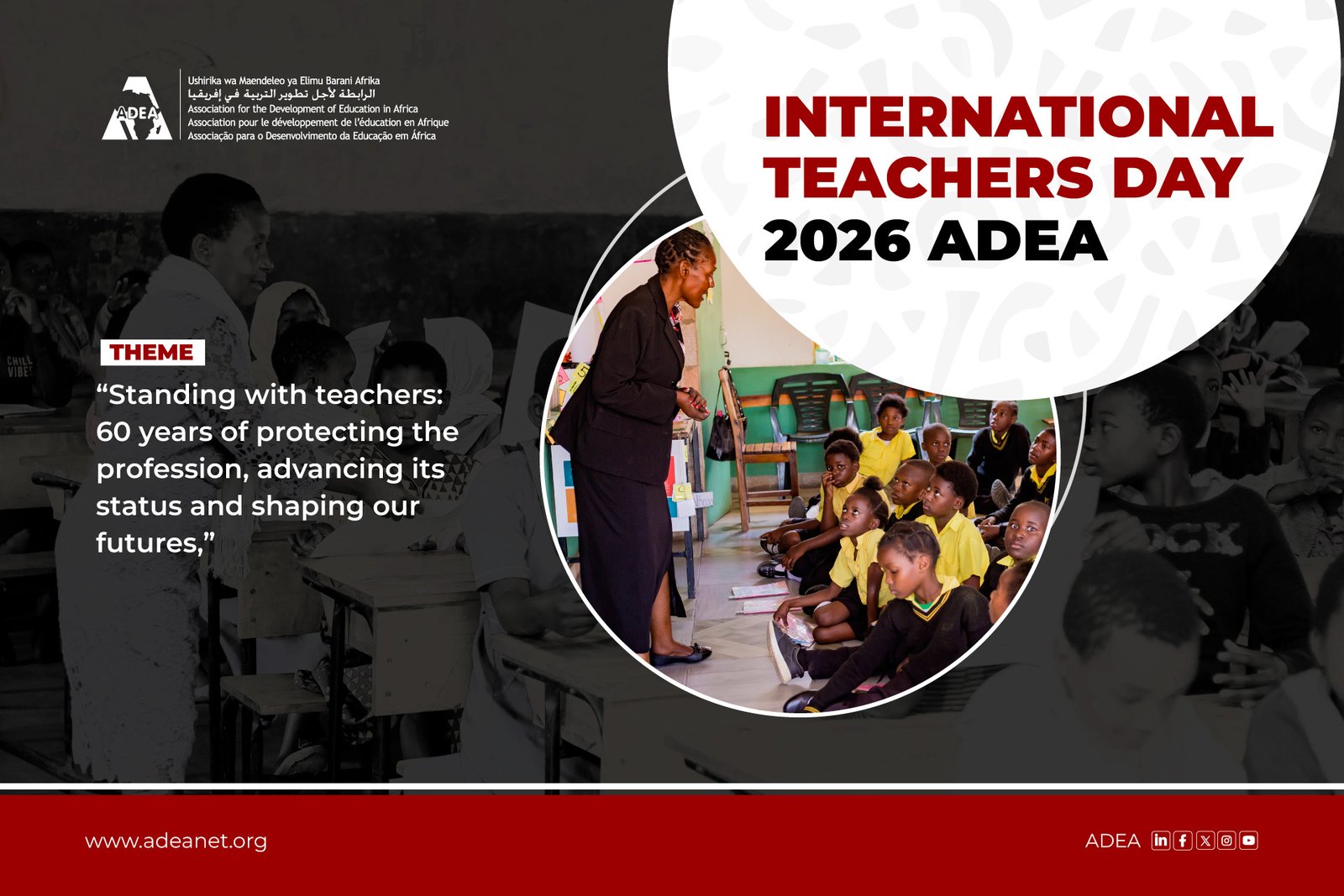
On this World Teachers’ Day, the Association for the Development of Education in Africa (ADEA) joins the global education community in celebrating the women and men who open classroom doors every day, often in challenging circumstances, and dedicate themselves to helping every learner realise their potential.
This year’s theme, “Standing with teachers: 60 years of protecting the profession, advancing its status and shaping our futures,” marks six decades since the 1966 ILO/UNESCO Recommendation concerning the Status of Teachers. It is an important milestone, but also an invitation to reflect: Are we doing enough to protect, support and value the people on whom the quality of our education systems ultimately depends?
The question is particularly urgent for Africa. The global shortage of teachers remains immense, with millions more needed by 2030 to achieve universal primary and secondary education. For African countries, addressing this challenge is not simply about increasing teacher numbers. It is about attracting talented people into the profession, preparing them well, supporting their continuous development, providing the conditions and tools they need to succeed, and recognising teaching as the highly skilled profession that it is.
Across the continent, important commitments have already been made.
At the ADEA Triennale in Accra in October 2025, governments and education stakeholders called for stronger investment in education, better connections between teacher preparation and continuous professional development, stronger leadership and accountability, and greater attention to multilingual teaching and learning.
At the Africa Foundational Learning Exchange (FLEX2026) in Lilongwe in July, 42 African governments and the African Union committed to sustained action to tackle learning poverty. Their priorities included stronger financing for foundational learning, better use of data and accountability, scaling evidence-based approaches to teaching, responsible use of artificial intelligence and improving access to learning for vulnerable and hard-to-reach children.
These commitments matter because education transformation ultimately reaches the learner through the teacher.
ADEA has long recognised this, especially through our engagements. As a member of the consortium promoting the African Centre for School Leadership (ACSL), we are address systemic policy gaps that will help enhance school and teaching leadership. Through our Inter-Country Quality Node on Teaching and Learning (ICQN-TL), hosted by Rwanda’s Ministry of Education, we bring African countries, institutions and experts together to exchange evidence, strengthen capacity and develop context-responsive approaches to improving teaching and learning. Across our work on foundational learning, school leadership, education technology, skills development and education reform, one principle remains constant: we cannot improve learning without investing in those who make learning possible.
For teachers themselves, three priorities are becoming increasingly important.
First, we must keep every learner and the quality of their learning at the centre of the profession. Every child should have the opportunity to read with understanding, reason with numbers and build the foundations for lifelong learning. This means meeting learners where they are, using approaches grounded in evidence and, where appropriate, teaching children in languages they understand. At FLEX2026, pupils from Nkwiji Primary School reminded Africa’s education leaders of something fundamental: children themselves know what they need to learn. We must listen to them.
Second, teachers must be supported to use technology wisely and responsibly. Artificial Intelligence (AI) is rapidly changing education and can help teachers prepare lessons, develop learning materials, assess progress and provide additional support to learners. But technology cannot replace a teacher’s professional judgement, knowledge, care and understanding of the learner. Teachers need the skills to interrogate these tools, verify their outputs, protect learners’ data and determine when technology genuinely improves teaching and learning.
Third, we must make inclusion real in every classroom. Girls and boys, children with disabilities, displaced learners, children in remote communities and those facing poverty or other disadvantages must all have the opportunity to learn and thrive. Inclusion is ultimately experienced by a child through everyday decisions about who is welcomed, who receives support and who is given the opportunity to participate fully.
Teachers cannot carry these responsibilities alone.
To African governments and development partners, standing with teachers must mean more than words of appreciation once a year. It means adequate and timely remuneration, quality initial preparation, continuous professional development, professional recognition, supportive school leadership and access to the teaching and learning resources required to do the job well. It also means listening to teachers and giving them a meaningful voice in the policies and reforms that shape their profession.
The commitments made across the continent must now translate into better conditions in schools and classrooms. As Africa moves towards the next FLEX in Abidjan in 2027 and advances implementation of its continental education agenda, progress must be measured not only by the policies adopted, but by whether teachers are better prepared, better supported and better able to help every child learn.
Today, we celebrate Africa’s teachers not simply for their resilience, but for their professionalism, expertise and indispensable contribution to our collective future.
To every teacher across our continent: thank you for the knowledge you share, the potential you unlock and the futures you help build every day.
Africa stands with its teachers. ADEA stands with you.
