
Why foundational learning in emergencies cannot wait – What insights and evidence from Ethiopia tell us
© Photo: DTaremwa
On the 24th of January every year, the global community commemorates the International Day of Education, an opportunity to reaffirm a simple but powerful truth: education is a fundamental human right and a cornerstone of peace, resilience, and recovery. Yet for girls, boys and children with disabilities living through conflict, displacement, and climate shocks, this right is too often deferred.
Foundational Learning in Emergencies (FLiE) – the acquisition of basic literacy, numeracy, and social-emotional skills during the early and primary years for children affected by crisis – is not a privilege to be addressed once stability returns. It is a necessity for survival, recovery, and long-term development.
New rigorous evidence from Ethiopia shows that FLiE not only can be delivered in emergencies, but it also works to address learning poverty.
A learning crisis within a humanitarian crisis
Ethiopia is a crisis-affected country, facing overlapping shocks from conflict, drought, displacement, and disease. Today, more than nine million children are out of school. Learning levels are critically low, with most children unable to read or understand a simple text by the age of 10. Traditional rote‑based instruction cannot meet children’s academic or emotional needs. Trauma, instability, and chronic stress undermine children’s ability to learn, and without strong foundational skills, most will never catch up, even if they return to school.
Evidence that foundational learning works—even in emergencies
A recent meta-analysis of studies on what works to help children learn to read and do math in crisis settings shows encouraging news: it is possible to improve foundational learning even in conflict and crisis settings. In fact, the gains in literacy and numeracy can be as large-or even larger than those seen in more stable settings.
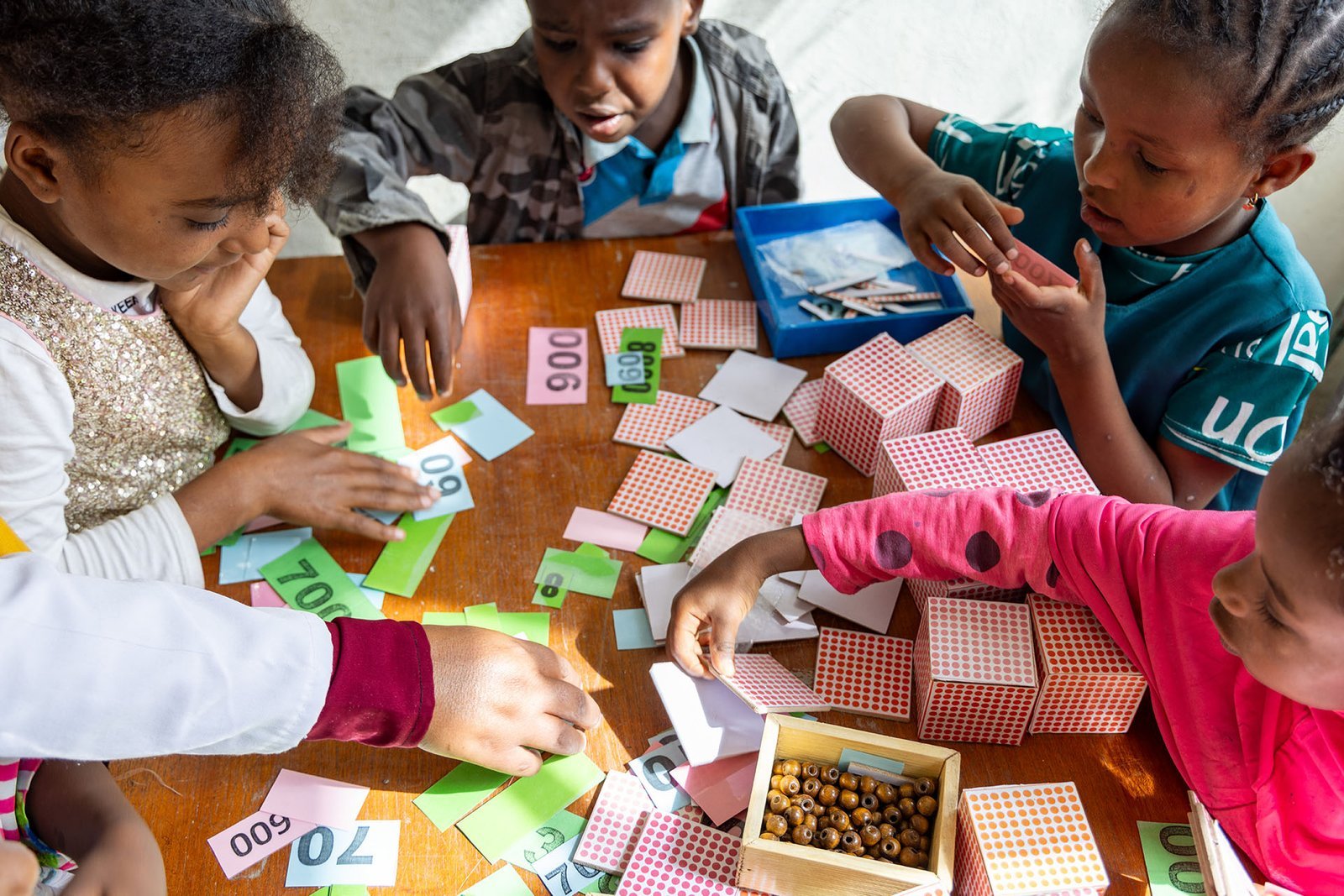
There are some interesting models that are beginning to show promise for the improvement of foundational learning outcomes in crisis contexts. A randomized controlled trial (RCT) of the ‘PlayMatters’ core package in Ethiopia’s Somali Region, including formal schools across both refugee and host communities, provides some of the strongest causal evidence to date. ‘PlayMatters’ uses Learning through Play, a child-centered, trauma-responsive, joyful approach that improves the quality of teaching, even with large class sizes in low-resource and crisis-affected contexts, while implicitly supporting children’s holistic development. The RCT followed more than 3,000 students and 500 teachers in refugee and host-community schools.
The results are striking:
- Large and statistically significant improvements in teaching quality, classroom management, and student engagement
- Large and statistically significant gains in numeracy skills, around twice the average impact of comparable education interventions in conflict settings, and gains in literacy skills that are on par with comparable literacy-focused interventions
- Exceptionally strong impacts on social-emotional learning, including empathy, emotional regulation, and conflict resolution—up to five times larger than average results of existing interventions in crisis contexts
- Positive improvements in children’s wellbeing (quality of life) and creativity, which are outcomes that are rarely measured, let alone achieved, in humanitarian education programs
Cost-effective, scalable, and system-relevant
Beyond impact, the PlayMatters study shows that FLIE interventions can be highly cost-effective. PlayMatters delivered the outcomes mentioned earlier at approximately $38 per child, about one-sixth of the average cost of education interventions in conflict-affected settings - while achieving equal or greater learning gains.
Crucially, the PlayMatters program was implemented in partnership with government, aligning with national teacher professional development and curriculum reforms. This demonstrates that FLIE is not a short-term project solution, but a scalable, system-strengthening approach that can endure beyond humanitarian funding cycles.
Aligning with what works
The evidence from Ethiopia aligns with a growing body of evidence from stable settings in Africa and beyond on what works to address learning poverty, including the following:
- Levelled learning/Targeted instruction (often called Teaching at the Right Level), implemented across several African countries, has consistently demonstrated that grouping learners by learning level rather than age can dramatically accelerate literacy and numeracy gains, particularly for children who have fallen behind due to disruption or exclusion.
- Structured pedagogy, implemented across multiple African countries at scale, involves providing teachers with simple scripted lessons and coaching support, plus learner books, to deliver foundational literacy and mathematics lessons.
There is growing evidence that adaptations of TaRL and structured pedagogy could be impactful for crisis contexts, as Luminos Fund has recently demonstrated with the integration of structured pedagogy into an accelerated education model in Ethiopia.
Looking forward
To commemorate this year’s edition of the International Day of Education, our core message is to reiterate that foundational learning must be protected and prioritized in emergencies, to ensure that children affected by conflict are able to retain equal opportunity at positive livelihood outcomes with the children from other contexts.
To achieve this, all stakeholders must support efforts at delivering what works at scale. For donors, policymakers, and partners working in crisis contexts this means:
- Recognizing that children affected by crisis deserve quality learning, not continued learning poverty.
- Investing early in foundational literacy, numeracy, and social-emotional learning, not postponing them until crises end.
- Funding evidence-based (and evidence-generating) cost-effective FLIE approaches that address both foundational learning and wellbeing.
- Integrating FLIE models into national education systems in support of government-led crisis response, even in fragile and conflict-affected contexts.
- Developing, testing and proofing a policy framework that establishes learning continuity methods when crisis breaks out. This way, learning systems can be resilient and crisis-proof.
The evidence from Ethiopia shows that when we invest in strong foundations, we give crisis-affected children more than schooling—we give them the tools to recover, adapt, and build a future.
Let us move beyond commitments to access alone. Let us stand behind Foundational Learning in Emergencies as a global priority, because learning cannot wait.
